


Bordeaux wines are one of the most expensive and invested-in wine regions in the world.
Sweet wines from Bordeaux have been genericized to ‘Sauternes,’ although they come from 10 different appellations in the Bordeaux region all around the river Garonne. Sauternes is but one – one of the southernmost village as seen on the map below.
As noted in our Sweet Wine introductory post, Bordeaux’s sweet wine production has fallen drastically since WWII when it was 32% but now stands at just around 1% of all wine produced.
There are 10 sweet wine appellations in Bordeaux making dessert wine (semi-sweet wines called moelleux are produced in the wider region outside of the 10 villages designated below). The most well-known are sweet wines of Sauternes, Barsac & Cerons. Sauternes & Barsac contribute about 2/3 of the planted area of the 3,300 hectares (note that Barsac can use the Sauternes appellation).
The other villages are interesting to explore and since they are less known, one can get better value on purchase – however keep in mind that the maximum allowed yields per hectare can be up to double than that of Sauternes & Barsac – thereby impacting quality.
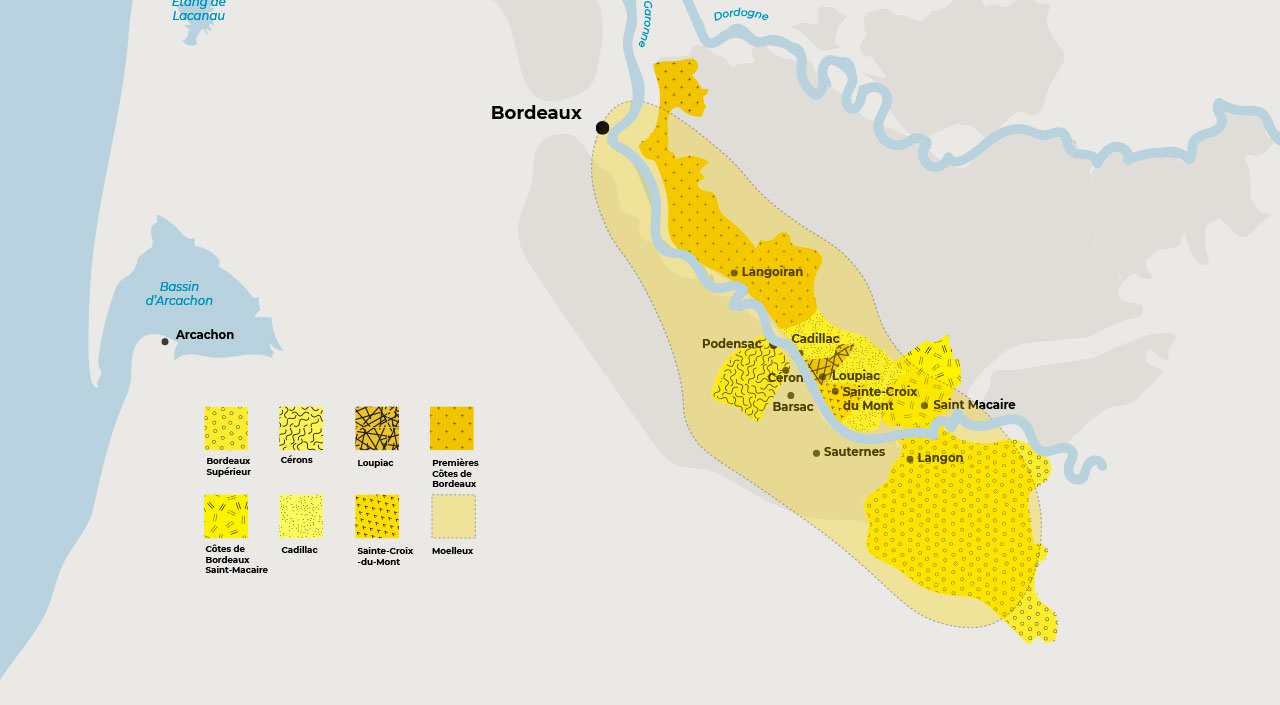
Bordeaux Sweet Wine Appellations Map
Map from Bordeaux Blanc
- Sauternes
- Barsac
- Bordeaux Supérieur
- Cadillac
- Cérons
- Côtes de Bordeaux-Saint-Macaire
- Graves Supérieurs
- Loupiac
- Premières Côtes de Bordeaux
- Sainte-Croix-du-Mont
Styles of Sweet & Semi-Sweet Bordeaux Wine
Sweet Wine
A liquoreux style – this is what most people associate sweet / dessert wines with Bordeaux, the viscous and the sweeter style. They are more concentrated, always made from botrytis affected grapes, as discussed in the ‘Note on Botrytis’ section of our introductory sweet wine post. Sweet wines can age exceptionally well, and an ultra-premium Sauternes is typically not consumed before at least 20 years of aging.
Semi-Sweet Wine
Known as moelleux – these are semi-sweet wines with their own AOC and cover the entire Bordeaux region (outside of the 10 villages making sweet wine). Here fermentation is stopped through various methods when the sweetness level desired is reached, killing off the yeast before consuming all the sugar so that some is left in the wine. The sweetness level of moelleux is similar to our Bee d’Vine honey wine Demi Sec still or Demi Sec sparkling.
Taste and Serving (Sweet Style)
Sauternes are oaked, they have an acid backbone and are very sweet (120-160 Grams per liter of sugar) but not as sweet or acidic or as say a Hungarian Tokai or the various German sweet wines – look out for those in future blog posts. You can expect an alcohol percentage of generally between 12-14% for sweet Bordeaux.
However, they are more alcoholic, which adds to the sensation of weight or viscosity. As a rule, sweet Bordeaux wines are affected by botrytis and the blend is typically Sémillon 75-80% Sauvignon Blanc 15-20% and about 5% Muscadelle.
One can serve a Sauternes wine as a luxurious dessert by itself and experience notes of butterscotch, apricot, and honey arguably with greater impact than if accompanied with a dessert dish. Of course, one classic combination could be hard or blue cheeses whose sharp and salty flavors will balance the sweetness of the wine.
Production
Chateau d’Yquem, the pioneer of Bordeaux sweet wine, mentioned the word sweet wine ‘moelleux’ in 1816 and ‘triage’ in 1810. Moelleux is the French word for sweet wine, and triage refers to the practice of multiple rounds of hand harvesting only the clusters affected by botrytis or noble rot (and not the whole vine) – a time intensive practice!
The triage, or tries, can range from 3 times up to and more than 10 – sometimes one berry at a time!
In Bordeaux the maximum production allowed is 25 hectoliters per hectare, but the finest sweet wine chateaux produce in the range 9-15 hectoliters per hectare.
Relative to the sweet wine regions of Germany, the other ultra-sweet heavyweight of Europe, Bordeaux is a small region so there is more consistency, but the unpredictable seaboard facing climate in Bordeaux increases vintage variation (which they would say is a good thing!). There is however a stronger risk of hail and storms due to the later harvest extending to even the end of November.

Château d’Yquem 1921 Sauternes (~$12,000)
Sweet & Semi-Sweet Bordeaux Wine Recommendations
Chateau d’Yquem was mentioned by Thomas Jefferson in 1787. Currently they are under corporate ownership of the international luxury consortium LVMH and produce 8,000 cases per year.
Not to worry though …!
None of the Bordeaux wine recommendations below are promoted by contemporary politicians nor are any of them corporations – just well-made, natural wines, from approachable family vintners and represent good value.

At Vignobles Chaigne et Fils (organic/bio) with Proprietor/Winegrower Régis Chaigne & Business Development Dir. Laetitia Arpagian
Here are my recommendations of 15 producers I’ve met (and their wines that I’ve enjoyed!) presented in no particular order. You will find sweet and semi-sweet Bordeaux wines on the list:
| Chateaux | Styles / AOC | Contact & Information |
| Château Les Bertrands* | Moelleux | https://www.vignobles-dubois.com/ |
| Vignobles Moze-Berthon* | Pomerol – Saint-Emilion – Montagne Saint-Emilion | https://www.bayle-carreau.com/ |
| Vignobles Bayle Carreau* | Sweet white wine, semi sweet sparkling white and rosé wine | https://www.bayle-carreau.com/ |
| Vignobles Buffeteau* | Moelleux | https://www.vignoblesbuffeteau.fr/ |
| SCEA Vignobles Mallard | Semi sweet white and rose wine, Sauternes | https://www.laurent-mallard.com/ |
| Château Les Pâques | Sauvignon Bordeaux Moelleux | http://chateau-les-paques.com/ |
| Reflets D’Estuaire | Sauternes, Ste Croix du Mont, Monbazillac | reflets.d.estuaire@gmail.com |
| Château La Tour Blanche* | Sauternes | https://www.tour-blanche.com |
| Chateau Simon* | Sauternes, Barsac, Graves Supérieurs | https://www.chateausimon.fr |
| Château Bois Malot* | White sweet wine, in AOC Bordeaux Supérieur | https://www.bois-malot.com/ |
| Grandissime SAS* | Specialized in Bordeaux and South West region wines | https://grandissime.com/ |
| Bordeaux Families, Aline Migneault* | Moelleux, Sémillon, Sauvignon grapes still wine. Sparkling demi sec | https://www.bordeauxfamilies.fr/ |
| Vignobles Boudat Cigana | Bordeaux Moelleux, Sainte-Croix-du-Mont, Vin de France, Sauternes, Monbazillac, Graves Supérieur | https://www.vignobles-boudat-cigana.com/ |
| LARRAQUE VINS INTERNATIONAL* | Sémillon, Muscadelle | https://larraquevinsinternational.com/ |
| Vignobles Chaigne et Fils | Moelleux | https://www.chaigne.fr/ |
| Château Camille Gaucheraud | 100% Sauvignon Blanc Moelleux | https://www.camille-gaucheraud.com/accueil/ |
* Available in USA through importer/retailers (for others order directly).
The last one, Château Camille Gaucheraud is in Blaye-Côtes-de-Bordeaux which is about 20 miles north of Bordeaux.
If you’re in that part of the world stop in and say hello to a friend and fellow American, Jesse Knight ‘Man Vs Wine!’ Do yourself a favor and join a wine tour with him (or at the very least follow him @manvswine if you can’t just get up and go to Bordeaux). You may sign-up for his independent MAN VS WINE club that regularly sends quality Bordeaux wines from small French producers direct to your home worldwide. He may be able to include some of the recommended wines from above, or your favorites, direct from Bordeaux.
Cheers and stay sweet!
Ayele Solomon
Bee d’Vine Winemaker