

Drink natural wines or commercial wines, that is the question. If you’ve ever been overwhelmed and paralyzed with indecision in a wine shop or supermarket wine aisle, you’re not the only one.
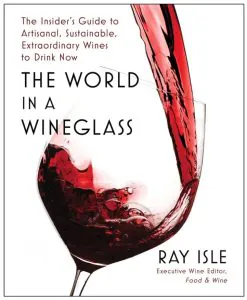
Imagine the canned soup aisle with cans of soup ranging in price from fifty cents to $50 AND with none of the ingredients listed! That’s the analogy Ray Isle gives in his new book The World in a Wineglass: The Insider’s Guide to Artisanal, Sustainable, Extraordinary Wines to Drink Now (Published by Scribner, 720 pages, 24 hours in audiobook, full Index).

I met Ray about 10 years ago when launching Bee d’Vine. I contacted many prominent journalists around the country, and as the Wine Editor for Food & Wine Magazine, he received my handwritten letter and copy of our introductory honey wine book. In two weeks Ray was tasting my wine on national TV on the TODAY Show – this was a surreal moment – with zero PR budget & less than a month on the market, a real shot in the arm! Then in 2019 Ray included me as one of the Tastemakers in this Food & Wine article.
Naturally, one of the first things I did, after the 2023 year-end peak sales period, was purchase and read his book.
The bulk of the book is what I would call a field guide – sorted by the famous wine regions with rich regional historical context, anecdotes of the producers, wines, wineries that Ray has met. And of course detailed recommendations of specific wines along with their prices.
(Note, reference books are naturally not good in audio format so I found the audiobook is suitable if listening purely for general appreciation).
The wines are noted with a simple 4-tier price rating system of $, $$, $$$, $$$$ and essentially all the wines are under $100.
You might as what are the best natural wines near me? Ray has you covered, hopefully live near one of these wine regions! The countries and sub-regions covered are presented this order:
- France – Alsace, Beaujolais, Bordeaux, Burgundy, Champagne, Jura & Savoirie, Languedoc-Roussillon, Loire Valley, Provence & Corsica, Rhône Valley
- Italy – Northern (Alto Adige-Trentino, Emilia-Romagna, Friuli-Venezia Giulia, Piemonte, Veneto). Central (Abruzzo, La Marche, Tuscany, Umbria & Lazio). Southern (Basilicata, Calabria & Puglia, Campagnia & Molise, Sicily & Sardinia)
- Spain – Galicia, Rioja & Navarra, Castilla y León, Catalunya & the Mediterranean Coast, the Islands
- Portugal
- Austria & Germany
- Slovenia, Georgia & Lebanon
- USA – California (North Coast, Central Coast & Beyond). Oregon. Washington.
- Australia & New Zealand
- Argentina & Chile
- South Africa
Ray writes, “Wines I remember best have one thing in common, surprising it’s not how delicious they were…they offer something more, and that’s what the wines in this book do.”
Paraphrasing from one of four opening chapters, “How to Drink wine,” the wines he remembers most are influenced by any or all of these – the winemaking, viticultural choices, history of makers, expression of terroir & winemaker sensibilities, how it’s distinct from other wines….how it tells a story.
Another opening chapter is on Sustainability which is the best explanation of the complex world of terms like “natural wines,” “organic wine,” “biodynamic,” “organically grown” – in my opinion. The chapter is not just an academic treatise but a real-world explanation of how these terms came to exist and how they are practiced along with discussion on the personalities that drove the natural wines movement, statistics of are under natural wines management by geography, etc.
There are many different interpretations of these terms by winegrowers and legally regions and jurisdictions – which are discussed in very digestible prose.
It’s hard to cover all topics on sustainability particularly when the focus of an already 700+ page book is on wines and wineries. So it would behoove the reader to find other texts on winery sustainability. For example, irrigation – a significant driver of winery environmental impact especially with the addition of global warming, prohibited in some countries and regions – compared to dry-farming, was not discussed. Another example is the use of very toxic soot belching oil heat lamps (most commonly employed in France) used to avoid vineyard frost.
Yet, a very interesting point made about the best natural wines and organic wines is that small producers largely live on the vineyard property, so they have skin-in-the game not to use synthetic chemicals that affect their personal, bees, soil and grape health. Whereas corporate farms are a textbook definition of moral hazard.
Having taken responsibility for managing a small (noncommercial) family vineyard that I converted to organic, I know of what he writes and I am intimately aware of the challenges to make the best natural wines and organic field-blend wine. Ours is noncommercial in the true sense of the word, meaning we don’t sell the one-barrel field blend.
Commercial, or engineered wines are made by design to tick (trick?) the palate & olfactory sensations – like the national brand potato chips designed to keep you salivating for more. A Taco Bell taco vs the family owned Mexican restaurant tacos with soft, stoneground corn tortillas and local ingredients is how Ray juxtapositions natural wines vs what I call engineered wine (check out the duck carnitas taco equivalent of the best natural wines that Ray presents from Austin’s Chef Edgar Rico).
Ray non-judgmentally points out that both can taste good and be enjoyed, but to truly enjoy a wine, one has to embrace the holistic experience. Essentially, it’s the story behind the label and practices used in growing and making the wine that’s part of the experience.
I asked Ray why he wrote the book. So in his own words, he did it because he wanted to call attention to all the great, independent vintners out there in the world who are working in ways that both benefit rather than damage the environment, and are also making great wines that express the place they’re from as well as a kind of personal vision, or passion.
There’s no one in it that he had not spoken to personally, either at their property or at tastings in New York City (with a pandemic exception for some zoom calls), and all the wines are relatively affordable. There are plenty of places working the same way at the higher stratosphere of wine pricing — Domaine Romanée Conti, for instance — but he wanted to cover wines that people could actually buy, and also profile some less exalted properties that people might not already know about. We are restricted more with our imagination than our wallet – to emphasize, he is not writing about unaffordable wines – such as Opus One – but affordable ones and in some cases relatively undiscovered ones.
Indeed, there is truly a big division in wine right now – between mass-produced, conventionally farmed, semi-anonymous, engineered wines — some of which taste fine, but all of which lack any kind of real sense of place, or even soul — and those made by independent vintners, who are there in the winery and among the vines, who are deeply invested in what they’re making.
On blind tastings: No one tastes wine that way, it “denatures wine…wine is lifted by memories…our brains manufacture pleasure out of more than the alcoholic liquid that is touching our tongues.” According to Ray, the writing is on the wall, blind tastings and rating system popularized by Robert Parker and later by the Wine Enthusiast are on their way out and few sommeliers or restaurateurs worth their salt pick wines based on ratings.
There are many engineered wines to choose from, often owned by multinational corporations who buy many smaller wineries every year. One was proud to use “a 360-degree marketing plan”— a conglomerate owned New Zealand Sauvignon Blanc in this case. But a quick story before (my own) caveat emptor list of the usual suspects.
In 2018, we, as in The Honey Wine Company, had a booth at Prowein in Dusseldorf, Germany (the largest wine show in the world with about 6,000 exhibiting wineries and a tremendously tasty & thrifty vacation idea for a wine lover who attends pretending to be in the industry) in the shadow and directly opposite 19 Crimes Wine from Australia. They had a massive pavilion-like booth with hundreds of people entering every day (while we, like most small producers, only had a couple dozen or so over 3 days).
What intrigued me was that not a single person, out of the many dozens of their employees, had any inclinations to step a meter, or about 4 feet, for 30 seconds to freely sample something they would probably never taste in their entire lives – a honey wine from Sonoma. This is after making eye contact with me over three days!
I made it a point to try a couple of the “Crimes,” clearly not my words. They were quaffable, without any winemaking faults (I’ve developed sense for chemically manipulated wines so I know it was more than grapes, yeast & sulfur) but alas this was before the Snoop Dog 19 Crimes label – one of my favorite rappers of old.
The engineered wines and livelihoods around them are an excusable necessity. However, the uncurious mind is disappointing, if not an inexcusable crime! Anyway, some of the best-known engineered wines are: Stella Rosa, Barefoot wine, Menage a Trois, Josh Cellars, Kim Crawford, Apothic and of course 19 Crimes. You can get them from a box store like a Total Wine near you, but consider picking up The World in a Wineglass and getting something else with personality even if for special occasions.
For me, making natural wines are something you can’t live with and something you can’t live without; a labor of love. Bitter sweet as the risks are high and the monetary rewards small – none in our case. Though the joys of drinking it, even the risks associated in producing it, are intoxicating. Managing the vineyard & pests using organics is punishing work.
Natural wine makers are often tempted to pushing the boundaries, so you’re likely going to get a more innovative wine, perhaps an extraordinary one with character. For example, on the 2021 vintage, I wanted to do the most days of cold soaking grapes for maximum color extraction. Of course there is a risk of producing ethyl acetate (the smell of nail polish remover) caused by bacteria. “You don’t know how fast you can drive on the track until you drive off” a winemaker mentor once told me…
Indeed I “achieved” the start of nail polish smell – but recovered through aerating the hand destemmed grapes – only to discover that I made an over-the-top, deeply tannic wine which will probably need a good 8 years in the bottles to balance out and hopefully be fantastic.
Pushing the boundaries, could the difference between the best natural wines and engineered wine be the difference between a professional lover and true lover? There is no denying both exist.
The World in a Wineglass: The Insider’s Guide to Artisanal, Sustainable, Extraordinary Wines to Drink Now is an invaluable book collection for anyone interested in natural wines. But remember this review is not blind, and neither should your wine evaluations be.
Cheers to natural wines and congratulations to Ray Isle, bravo!
Ayele